| Description |
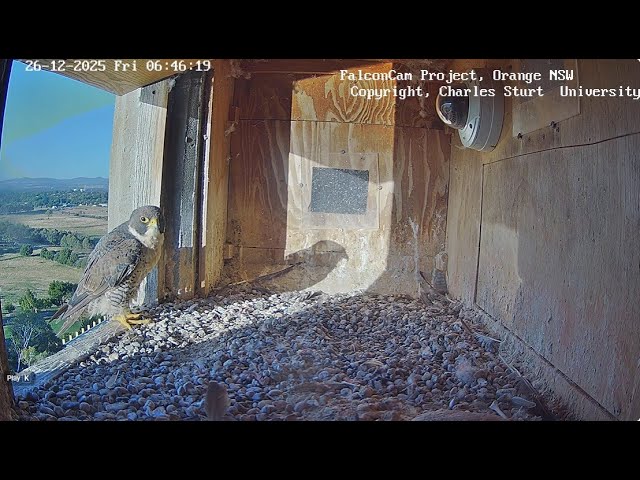
GENERAL INFORMATION This site follows a family of peregrine falcons using a nest box since 2008 in a water tower at Charles Sturt University, Orange, Australia.
The female is Diamond (aged at least 13) and the male is Gimbir (hard 'g' Gim-bear, meaning 'spring' or 'fountain' in the local Wiradjuri language) is in his second year.
For more general information, please see under the chat rules below.
NEWS 6th July
A bit of a slow start to the season. Some prey gift giving is occurring by way of Gimbir leaving prey (or remains) in the box for Diamond, although more often he eats it himself. She has been rejecting starlings again.
No mating has occurred to my knowledge. It is possible that it is occurring elsewhere, but this seems unlikely as Diamond has always presented herself on the tower in previous years. Assuming all goes well, we should have eggs by late August.
Gimbir is a skilled hunter and can show Diamond that he is a good provider, so we hope for the best. Here he is showing off his flying skills: https://youtu.be/UK-DCosgWVU
DONATIONS FalconCam is funded through donations and these can be made via the CSU shop https://falcon.shop.csu.edu.au. Thanks for your support.
LINKS
BLOG and WEBSITE can be accessed here: https://science-health.csu.edu.au/falconcam
Lots of infomation on the, website including links to my two papers (see Timeline, September 2023, breeding behaviour, and March 2025, courtship).
OTHER CAMS and VIDEOS can be accessed via this address:
https://www.youtube.com/c/FalconCamProject
CHAT RULES
To keep the chat open, pleasant, we have a few rules. Those flouting the rules will be warned and could be blocked by moderators (mods, with blue spanners). Inappropriate comments will be deleted.
And although not a rule, we ask that greetings, thanks etc. on chat are kept to a minimum during the busy season - a simple 'good morning, everyone' is fine!
1. Chat should be about this site, but significant events from other Australian sites can be posted without discussion. Out of the breeding season some chat about other birds is acceptable if not prolonged.
2. Use English in this chat. If you do not speak English, there are on-line translators available.
3. Do not criticize people’s attempts to write in English.
4. Do not ask for donations (except for this site), discuss politics or religion, advertise other sites or products (including videos), use obscene language or hate speech.
5. Avoid using panic language if you see something unusual and remember this is a wildlife project with limited interference by the project team.
6. Respect each others' opinions, even if you do not agree. Do not be rude or get into arguments with other chatters.
7. If a rule is broken and no mod is present, do not engage; simply refer people to the chat rules if you wish.
8. Remember mods are humans, too. Please respect their decisions.
9. Use emojis and symbols (e.g. !) sparingly: only one emoji per post, please. Don't use ALL CAPS as it sounds as if you are shouting.
HISTORY The birds have been observed using the tower (a working water tower) since 2007, breeding in the box since 2008, with an average of 2.8 eggs per clutch and 1.5 fledges per season.
The parents' names are Diamond (female) and Gimbir (male). Diamond took over from the older Swift in 2015 and Gimbir replaced Xavier late August 2025, who replaced Bula in 2016 (who in turn replaced our first male, Beau, in 2015). Xavier arrived just as the eggs were hatching and saved the season by providing for Diamond and her three chicks. Assuming that she was at least two years old when she arrived, Diamond is at least twelve years old (2025). Gimbir is approximately one.
The male is 15-20% smaller than the female, has fewer spots on the chest and has brighter yellow-orange talons and beak. The birds do not migrate and courtship rituals and some scrape (nest) building continues throughout the year, intensifying, along with food bringing by the male, in July and August. Eggs are laid usually in late August, with chicks hatching in early October and fledging in mid-November. The youngsters often stay around as late as March being taught to hunt by their parents, and often visiting the nest in the tower, so there is much to watch even out of the main breeding season. One male juvenile stayed until August the following year when his parents blocked his entrance to the box and he took the hint.
INFORMATION ABOUT THE RESEARCH?
Contact the principal researcher Cilla Kinross on ckinross@csu.edu.au |